The essentials
- Four classes based on slip resistance Rd, measured with a pendulum: 0 (Rd ≤ 15), 1 (15 to 35), 2 (35 to 45), 3 (above 45).
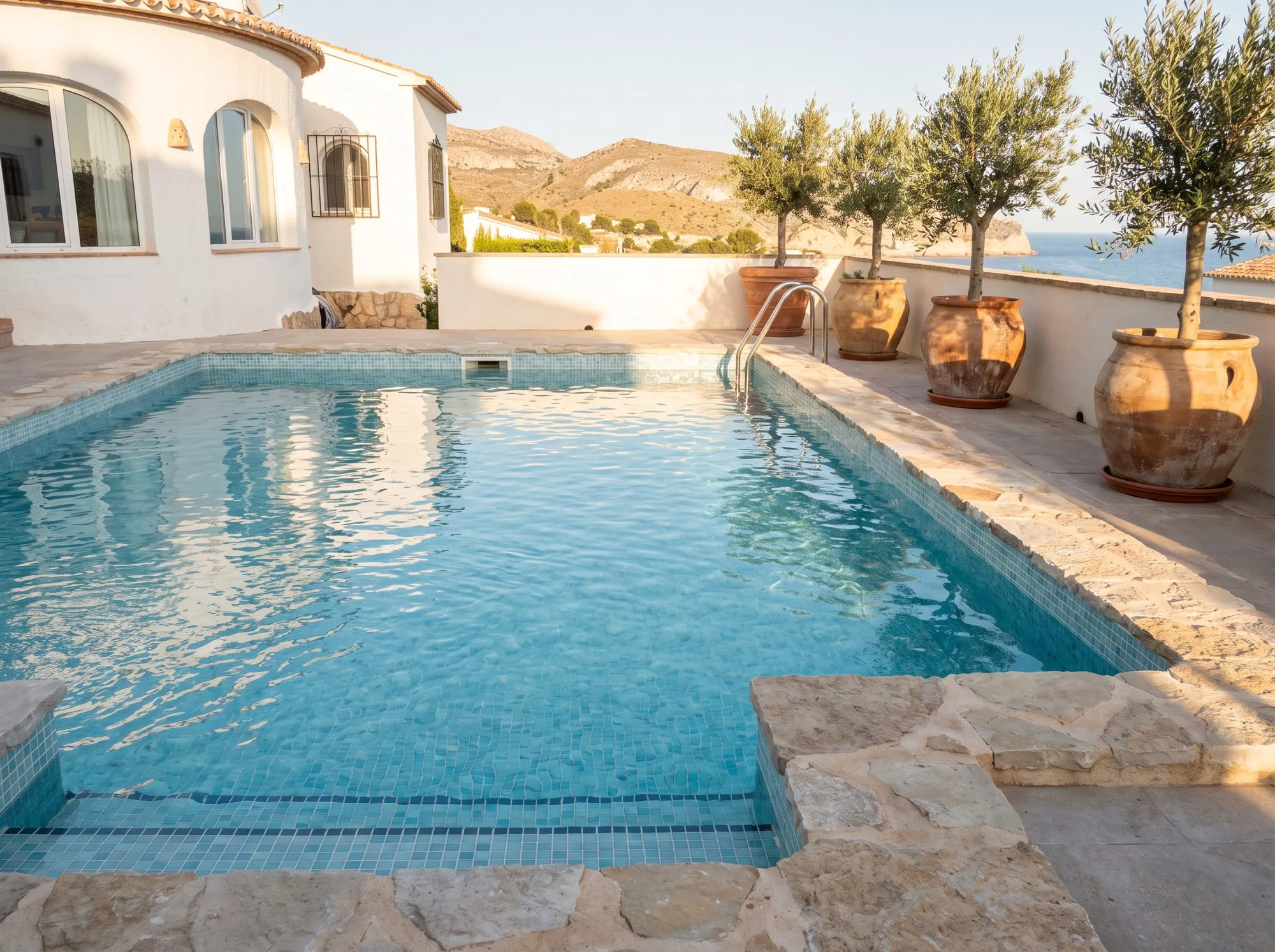
- Class 3 required outdoors, around pools (barefoot areas and the floor down to 1.50 m deep) and in showers.
- Bathroom, kitchen, covered terrace: class 2 on a flat floor (slope under 6%), class 3 above that.
- These classes are required for buildings open to the public; a private house is not covered by the text.
- The ministry also accepts as safe, without testing, floors rated at least R11 and, for barefoot areas, class B.
The classes of the Spanish Building Code
The Spanish Building Code (Código Técnico de la Edificación, CTE), in its basic document on safety in use (DB SUA, section SUA 1), rates floors according to their slip resistance, noted Rd. It is measured with a friction pendulum, on a wet sample, under standard UNE 41901:2017 EX or its European equivalent UNE EN 16165:2022.
The class must be maintained for the whole life of the flooring.
| Location | Slope under 6% | Slope of 6% or more, stairs |
|---|---|---|
| Dry interior | Class 1 | Class 2 |
| Wet interior: entrance, covered terrace, bathroom, kitchen | Class 2 | Class 3 |
| Outdoors, pool (barefoot areas, floor down to 1.50 m), shower | Class 3 | Class 3 |
In a private home: compulsory or not?
The requirement in section SUA 1 covers buildings used for public residential accommodation, healthcare, education, retail, administration and other uses open to the public. A private house is not included: at home, these classes are not a legal requirement.
Similarly, section SUA 6 on the risk of drowning applies to pools for communal use and excludes those at private houses.
These texts remain the best reference for choosing a surface: a class 3 floor around a pool is the one the CTE judges suitable for wet bare feet.
R11, class B: reading a tile's spec sheet
Spec sheets often show other ratings, from a ramp test (standard UNE EN 16165:2022, annexes A and B): an R class, such as R11, or, for barefoot areas, a letter class, such as class B.
The ministry's supporting document on slip resistance (DA DB-SUA/3, July 2024) states that there is no official correspondence between these ratings and the pendulum classes. It nonetheless accepts the following floors as sufficiently safe, without testing, as long as their surface is not altered afterwards (polishing, buffing):
- floors rated at least R11;
- class B floors, in barefoot areas such as showers and poolside areas;
- natural stone with a flamed or bush-hammered finish;
- concrete paving stones and slabs.
When choosing
For a pool surround, a terrace or a bathroom, three things to check:
- ask for the class (1, 2 or 3) or the Rd value of the tile, or failing that its R class or its barefoot class;
- aim for class 3 outdoors and around the pool, at least class 2 in a bathroom;
- avoid polishing or buffing a surface afterwards once it has been chosen for its grip.
Official sources
- Código Técnico de la Edificación, DB SUA, consolidated text (ministry, codigotecnico.org)
- Supporting document DA DB-SUA/3, slip resistance of floors, 15 July 2024
General information, written from the official texts cited and verified on the date shown. It does not replace advice from your town hall, your tax adviser or your architect, who alone can rule on your specific case.
Verified on